Happy 560th Birthday, Richard III!
With any luck, by your next birthday your bones will have been positively identified and given a proper burial!
Tuesday, 2 October 2012


Thursday, 27 September 2012
Richard, duke of York (1473-83)
Since Richard III’s birthday is next week (Tuesday,
October 2), it’s important to spread the word about all the Dicks in his life.
Last week we had Warwick the Kingmaker, previously we had Richard, duke of York
(his father), and today we’ll have his nephew.
As you astute readers no doubt suspect, little York was
one of the “princes in the Tower.” In conspiracy theories, he’s the one who
didn’t die and came back in the 1490s, bearing the name Perkin Warbeck, to
claim the throne. Perkin/Richard/whoever he was was not successful, but there
are scholars out there who contend that Perkin was the real deal.
Anyway, Richard, duke of York was the second son of
Edward IV and Elizabeth Woodville. He was born on 17 August 1473 (so he
probably died just before or very shortly after his tenth birthday). Richard
was made Duke of York before he was a year old, in May 1474; he was knighted in
April 1475 and made a Knight of the Garter in May 1475. Damn! That’s a lot of
honors for a kid who probably wasn’t even potty-trained.
Of course, the adults in poor Richard’s life seemed
content to put his life on the fast track to adulthood. Edward IV knew that he
needed to provide a substantial landed endowment for his second son, so that
the boy could be a great magnate and prop to his brother’s throne. Edward was
working on this endowment when an even better opportunity arrived – a rich
heiress! When her father died in January 1476, Anne Mowbray (who was all of
three going on four) was left sole heiress to the mighty pile of estates of the
Dukes of Norfolk. Negotiations for a marriage between Richard and Anne started
almost immediately; such a marriage would allow Edward to endow his son at
minimal cost to the crown (rather like what Edward did for his brothers with
the Neville lands). Richard and Anne finally married in January 1478 when the
groom was four and the bride five. Sadly, Anne Mowbray died at age nine in
November 1481, leaving her eight-year-old husband a widower.
After Edward IV died in 1483, Richard went into sanctuary
with his mother and siblings (minus his elder brother who was now king Edward
V). As was customary for medieval kings, Edward V was lodged in the Tower of London
to await his coronation. After the king had been there for several weeks, the
queen dowager was finally persuaded to release Richard from sanctuary so that
he could spend time with his brother. On 16 June 1483, Richard joined his
brother at the Tower, and (in all probability) neither boy ever left. It’s as
though the Tower swallowed them alive (or, you know, their uncle put out a hit
on them).
So that’s Richard, duke of York, younger brother of
Edward V. Given that he probably died at age nine, it’s no surprise we know so
little about him. I realize he had a life of privilege, but it’s a little sad
and a little mind boggling how accelerated his life was. He lived nine years
but he managed to “earn” a dukedom, be knighted twice, get married, and be
widowed before his premature death. That’s a lot of milestones for one so
young.
Rosemary Horrox, “Richard, duke of York and duke of Norfolk (1473–1483),” Oxford
Dictionary of National Biography, Oxford University Press, 2004
[http://www.oxforddnb.com., accessed 26 Sept 2012]
 |
| Richard, duke of York, from a stained-glass window in Canterbury Cathedral |
Thursday, 20 September 2012
Richard Neville, Earl of Warwick
Otherwise known as Warwick the Kingmaker.
Since Richard III has been in the news as of late (and there
was much rejoicing), I believe the time is right to give his cousin his due.
Despite being twenty-four years older than Richard III, Warwick was his first
cousin. This happens when your grandfather has fifteen children (with his
second wife; he had a bunch more with his first). Warwick’s father, Richard,
earl of Salisbury, was one of the eldest children, while Richard III’s mother,
Cecily, was the youngest.
Richard, earl of Warwick, was born on 22 November 1428. He
was betrothed to Anne Beauchamp when he was six (and she was eight). In 1449,
Anne’s niece died and she and Richard inherited the earldom of Warwick. Richard
Neville became Earl of Warwick in right of his wife.
Skipping ahead a few years, Warwick was extremely
influential during the Wars of the Roses. After the First Battle of St. Albans
(1455), Warwick became the Duke of York’s right-hand man. Long story short, he
was extremely influential in putting the House of York on the throne. When the
Duke of York was killed at the Battle of Wakefield (30 December 1460), Warwick
threw his support behind York’s son Edward, earl of March. With Warwick’s backing,
in early 1461, Edward was able to claim the English throne as King Edward IV.
Edward recognized that he owed Warwick big time. He showered
the man with favors and even sent his younger brother (the future Richard III)
to Warwick’s northern castle of Middleham to be trained in the knightly arts.
But the honeymoon period was not to last. In 1464, Edward disregarded Warwick’s
carefully-arranged diplomatic marriage and married Elizabeth Woodville, a noble
English widow. Elizabeth had a large family, and Edward proceeded to reward
them. Historians disagree on whether Edward extravagantly rewarded the
Woodvilles or kept within the bounds of reason (forming a loyal affinity), but,
suffice it to say, Warwick was pissed. The earl became even more upset when
Edward began to pursue a foreign policy he did not agree with. Furthermore,
Edward, as he matured, was becoming his own man. The king had been young – only
eighteen – when he first ascended the throne, but he became more confident and
more willing to exert his authority as he grew older. This meant that Warwick
needed to be content with a smaller role (after all, he was not king); this was
something Warwick found very hard to accept. It eventually led to a complete
breach between the two.
In 1469, things came to a head. The Neville family fanned
the fires of popular discontent and created a few uprisings. In July, Warwick,
with his elder daughter Isabella and Edward’s brother George, duke of Clarence,
sailed to Calais; in Calais, George and Isabella married. George then joined
with Warwick is condemning his brother’s rule. The icing on the cake, for
Warwick, came when Edward’s army was defeated in battle and the king was
captured. He was kept as a personal prisoner of Warwick, who had the imprisoned
king stay at his castles. Luckily for Edward, people got wind of what Warwick
had done and, fearing that Warwick would replace Edward with his brother George,
rebelled again. Warwick was forced to release Edward so that the king could put
down the rebellion.
In the winter of 1469-70, the king and Warwick tried to
resolve their differences. It didn’t work; Warwick took his family and left for
France, while Edward set about systematically dismantling Warwick’s network of
supporters. The big shock came when Warwick allied with Margaret of Anjou, former
queen of England.
If you know anything about the Wars of the Roses, you
already have an inkling of why this alliance was shocking: Warwick was a Yorkist
while Margaret was a Lancastrian queen. The Yorkists had usurped the throne of
Margaret’s husband, Henry VI, and (probably a more grievous sin in her eyes)
denied her son his birthright. Warwick, in fact, back in the 1450s, had even
said that Margaret’s son was a bastard – so the two weren’t exactly friends. It
was a sign of how desperate both parties were that they allied. Warwick’s
younger daughter Anne married Margaret’s son (another Edward) to seal the deal.
Warwick then returned to England to put Henry VI, who had been chilling in the
Tower of London for a decade, back on the throne.
Initially, Warwick was successful. On the verge of being
trapped between one of Warwick’s armies in the north and one in the south, Edward
and his allies fled to the Low Countries in autumn 1470. Warwick restored Henry
VI to the throne. But Edward was able to secure support from the Duke of
Burgundy and he and his followers returned to England in March 1471. The two
camps began marching towards each other, preparing for pitched battle. Warwick
probably felt confident he could defeat Edward, but the earl’s hopes were
undermined when George, duke of Clarence, finally decided to return to his
brother’s side. On Easter Sunday, 14 April 1471, the two sides met at Barnet
(now part of greater London). Warwick was killed in battle and Edward was
victorious.
Edward’s throne was secure after the Battle of Tewkesbury on
4 May 1471. Margaret of Anjou’s son was killed and Margaret herself captured.
She was kept imprisoned in England for a time until the French king ransomed
her. Henry VI was murdered (or died of melancholy if you are a die-hard Yorkist
who believes propaganda). Anne Neville, younger daughter of Warwick and widow
of Margaret’s son, married the future Richard III and eventually became Queen
of England (for a brief while).
Although Warwick had held his earldom in right of his wife
(who was very much alive and would remain so until 1492), all his lands were
confiscated and doled out to George and Richard, the king’s brothers and
Warwick’s sons-in-law. This was pretty shitty to the countess, but Edward
needed to reward his brothers and using someone else’s land was the easiest,
cheapest way. The countess of Warwick eventually went to live with Richard and
Anne in northern England (presumably by choice, but we’ll never know for sure).
Warwick is called “the Kingmaker” became he made and unmade
both Edward IV and Henry VI. As you might expect from a man who makes kings,
Warwick was a tad on the arrogant side. Nevertheless, he had real grievances
against Edward IV. The whole incident just shows what a debacle the Wars of the
Roses were; it was not one of England’s finer moments.
Source:
A. J. Pollard, “Neville, Richard, sixteenth earl of Warwick and sixth earl of Salisbury [called the Kingmaker] (1428–1471),” Oxford Dictionary of National Biography,
Oxford University Press, 2004; online edn, Jan 2008 [http://www.oxforddnb.com,
accessed 19 Sept 2012]
Friday, 14 September 2012
Dicks and their Bones
So archaeologists have (probably) found the body of
Richard III (http://www.bbc.co.uk/news/uk-england-leicestershire-19561018). At long last! This discovery is almost worthy of a holiday in my book
(FYI: Richard III’s birthday is coming up – October 2 – and that is a holiday
in my world). To honor this epic discovery, I thought I would provide a quick
rundown of the fate of the bones of all three Royal Dicks.
Most of Richard I was buried in Fontevrault, an abbey in
France. This is not surprising for two reasons 1) both his parents are buried
there and 2) the man loved France and spent way more of his time there than he
ever did in England. I said most of Richard is in Fontevrault because his heart
was buried in Rouen Cathedral and his entrails in Châlus, where he died. Yes,
being buried in more than one place was a definite thing in the middle ages (at
least for aristocrats). The medieval Catholic church was actually not too keen
on people being dismembered and buried in any number of places, but they
couldn’t stop the rich and important from doing whatever they wanted.
Personally, if I ever become a somebody (not likely) I want my bits and pieces
scattered as many places as possible. Unfortunately for Richard and his ‘rents,
Fontevrault did not make it through the French Revolution unscathed. Their
bones are probably lost.

Richard II had carefully planned ahead to ensure the best
possible setting for the eternal repose of his mortal remains. When his wife
Anne of Bohemia died in 1394, Richard contracted with artists and builders to
construct a beautiful double tomb (the first double tomb for royalty in
England) in the shrine of Edward the Confessor in Westminster Abbey. Anne’s
body was placed in the tomb and Richard waited to join her. He unfortunately
went to his everlasting reward a bit earlier than he had intended; after his
deposition in September 1399, he was starved to death by his cousin and
successor Henry IV. After his death, Henry originally sent Richard’s body to
the Dominican friary in Kings Langley. Richard remained there until 1413, when
Henry V (son and successor of Henry IV) moved Richard’s body to Westminster
Abbey as a sign of political healing. Ever since, Richard has rested beside his
beloved Anne.
However, the couple’s rest has not always been … restful.
The tomb’s decorations began to come unattached in the eighteenth and
nineteenth centuries, revealing holes. Schoolboys at Westminster School (which
meet on the abbey grounds) would stick their hands inside and fiddle with the
bones. Sometimes, they even stole them. Richard’s jawbone was taken by a
student in 1776; it was finally returned in 1906.* Rumor has it, the family
passed the jawbone down through the generations and were using it as a
paperweight before Westminster Abbey demanded it back. Anyway, when the tomb
was opened in 1871, many of Richard and Anne’s bones were missing. Some, such
as the jawbone, have been returned; others are gone forever. As creepy as it
would be to have a bone for a paperweight, I would love to have a bone from either
Richard II or Anne of Bohemia. It would be so sweet!
*Dates on the jawbone: http://rictornorton.co.uk/westmin.htm.
 |
| From Westminster Abbey website |
 |
| From Westminster Abbey website |
Finally, Richard III. After his death at Bosworth, he was
interred at the Franciscan church in Leicester. That church was destroyed after
the Reformation; eventually the area became a parking lot. And now, Richard’s
body has been found, underneath said parking lot. Huzzah!
There was no guarantee the archaeologists would find
Richard’s body. Some stories said the king’s body was thrown into the River
Soar when the church was destroyed. It would appear that was not true.
 |
| Memorial to Richard III in Leicester Cathedral |
Bonus: Richard, earl of Cornwall
This Richard was the younger brother of Henry III.
Richard was also elected King of the Romans (actually king of Germany), so he’s
suitably royal. He was buried at Hailes Abbey, a Cistercian monastery he
founded in Gloucestershire. The church
and tombs at Hailes have all been destroyed, although the ruins are a tourist
attraction run by English Heritage (I’ve been – it’s great). Richard is buried
somewhere near the altar, and unless someone has pilfered it (unlikely), his
skeleton should still be there. When I visited Hailes, I walked over every inch
of the ruins of the church, just so I could be sure I had been on the spot of Richard’s
grave.
 |
| Ruins of Hailes Abbey (not the church) |
Monday, 10 September 2012
Richard Parkes Bonington (1802-28)
This Richard is a British landscape painter, who died
tragically young of tuberculosis. Richard was born in 1802 in a village near
Nottingham; for economic reasons, his family moved to Calais in 1817. Although
Richard had some artistic instruction from his father, his earliest watercolors
date from once he was in France and studying with an outside instructor. In
1818 the family relocated to Paris, and Richard joined a famous studio. He
worked exclusively with watercolors until 1824 when he started to focus on oil
paintings; in both mediums he focused on marine landscapes. In the mid-1820s,
he journeyed throughout Europe, visiting England, Normandy, Venice, Florence,
Pisa, Genoa, and Basel (among other places). During the last two years of his
life, Richard expanded beyond marine landscapes and painted views of Venice and
illustrations to works of medieval history or historical fiction (such as
novels by Sir Walter Scott). According to his entry in the Oxford Dictionary of National Biography, the development of Richard’s
“painting technique was breathtaking and experimental. By the summer of 1827
there was little but scale to distinguish visually between his work in oils and
his work in watercolours.” (Pretty impressive, eh?)
Richard collapsed in June 1828, weakened by either
sunstroke or exhaustion, and later fell ill with tuberculosis. His parents took
him to London in August, but treatment failed and he died on 23 September 1828
(about a month before his twenty-sixth birthday). Richard had actually been
quite famous in his day, so his passing was widely mourned.
According to the painter Eugene Delacroix, a close friend
of Richard’s:
“To my mind, one can find in other modern artists
qualities of strength and of precision in rendering that are superior to those
in Bonington's pictures, but no one in this modern school, and perhaps even
before, has possessed that lightness of touch which, especially in the
watercolours, makes his work a type of diamond that flatters and ravishes the
eye.”
Source:
Patrick Noon, “Bonington, Richard
Parkes (1802–1828),” Oxford Dictionary of
National Biography, Oxford University Press, 2004 [http://www.oxforddnb.com,
accessed 10 Sept 2012]
And now for some images! Here are a few of Richard’s
paintings.


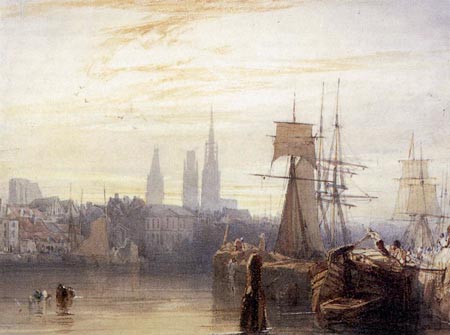
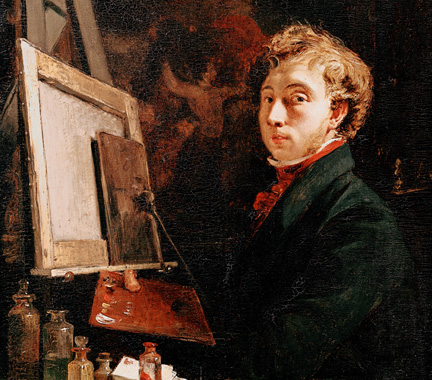 |
| Self-Portrait |
Monday, 3 September 2012
Richard Fitzalan, Earl of Arundel
School is back in session, so it’s time to feature a more
academic Dick. To that end, I give you Richard Fitzalan, fourth earl of Arundel
(and third earl of his family to have been named Richard), a medieval magnate
who lived from 1346 to 1397.
Some of you might well be thinking, “That name. Those
dates. I think I’ve heard of this guy before.” You would be correct! Richard,
earl of Arundel was one of the wealthiest, most important magnates during the
reign of Richard II, with whom Arundel did not get along at all. The two
supported radically different policies; for instance, Richard II sought peace
with France while Arundel objected, believing the terms of the peace were not
favorable enough to England. Richard II also sought advice from younger, less high-ranking
men, which irritated Arundel – he was the type of man (older, from an old noble
family) that the king should have been consulting.
Arundel became earl in 1376 at the death of his father
(another Richard). The elder Richard and Edward III had gotten along quite
well, and the elder earl had loaned the king a lot of money over the years. The
younger Richard provided the crown with a substantial loan in early 1377 (before
Edward III’s death), but from then on, he didn’t really lend any money to the
king. That was surely a sore spot with Richard II – while his grandfather had
been able to count on the Fitzalans for money, Richard II could not. It rankled
him.
But the two men were already off to a bad start when
Richard II was just a young’un. In the 1384 Parliament, Arundel gave an
impassioned speech in which he claimed England was in a state of decay and
desperately needed to be rescued from “the stormy whirlpool in which it is
engulfed.”* The king was present for this outburst, and naturally, Richard II
did not take too kindly to this. According to the Westminster Chronicle, he retorted, if “it is supposed to be my
fault there is misgovernment in the kingdom, you lie in your teeth. You can go
to the Devil!”* An eerie silence followed (everyone was probably thinking “oh
shit”) until one of Richard’s uncles stepped up, cleared the air, and made
everything better.
* Westminster
Chronicle 1381-1394, edited by L.C. Hector and B.F. Harvey (Oxford:
Clarendon Press, 1982), 69.
 |
| Sorry, but I love this meme. And it actually works fairly well for Richard and Richard. |
But things weren’t better for long. From late 1386 to
1389, a group of five magnates (called the Appellants (because they “appealed”
Richard’s friends for treason) essentially took over the government. The
Appellants were: Thomas of Woodstock, duke of Gloucester (and Richard’s uncle);
Richard Fitzalan, earl of Arundel; Thomas de Beauchamp, earl of Warwick; Henry
Bolingbroke, earl of Derby (later Henry IV); and Thomas Mowbray, earl of
Nottingham. Arundel, however, was one of the ringleaders (Bolingbroke and
Mowbray were less involved and are often termed the ‘junior Appellants”). These
men took away Richard’s power, nearly deposed him, and executed or sentenced to
death (in absentia) several of Richard’s friends. These friends included
Richard’s best friend Robert de Vere (who was spared execution so long as he
never returned to England), and the king’s old tutor Sir Simon Burley. Richard’s
wife, Anne of Bohemia, begged on her knees for Arundel to spare Burley’s life,
but it was to no avail. Burley was beheaded, and Richard never forgot (and
certainly never forgave) what Arundel had done.
The two Dicks, however, managed not to have a major
blow-up until the funeral of Anne of Bohemia (I wrote about this on August 3).
In short, Arundel arrived late, asked to leave early, and Richard hauled off
and smacked him. The king drew blood, and the funeral service was delayed while
Westminster Abbey was cleaned and reconsecrated. Arundel then had to spend a
week in prison in the Tower of London and was only released after paying a huge
bail.
But it wasn’t until 1397 that Richard II really struck
back. In July of that year, Richard arrested three of the Appellants
(Gloucester, Arundel, and Warwick). Gloucester was shipped over to Calais (an
English possession at the time) and secretly murdered; Arundel and Warwick were
charged with treason. Warwick admitted guilt and received a sentence of life
imprisonment, but Arundel denied the charges. He was accordingly tried and
convicted in Parliament in September 1397. Although sentenced to have been
drawn, hanged, and quartered, Arundel (thanks to his nobility) was beheaded on
Tower Hill – on the very same day he was declared guilty (they didn’t waste
time back in the day). Shortly after Arundel’s execution, there were rumors of
miracles happening at his tomb. Richard II had the body exhumed and reburied
elsewhere in an unmarked grave.
Although Richard II had taken down Arundel (and
disinherited the man’s family) in 1397, Arundel ultimately had the last laugh.
When Richard was deposed in 1399, Arundel’s son and heir was restored to the
family’s wealth and titles. Since Arundel was so often at odds with Richard II,
the earl’s reputation improved with the king’s deposition (in a sort of “the-enemy-of-my-enemy-is-my-friend”
fashion).
For more on Richard, earl of Arundel, check out:
C. Given-Wilson, ‘Fitzalan, Richard
(III), fourth earl of Arundel and ninth earl of Surrey
(1346–1397)’, Oxford Dictionary of National Biography, Oxford
University Press, 2004; online edn, Jan 2008
Chris Given-Wilson, “The Earl of Arundel, the War with
France, and the Anger of King Richard II,” in R.F. Yeager and Toshiyuki
Takamiya, eds, The Medieval Python: The
Purposive and Provocative Work of Terry Jones (New York: Palgrave
Macmillan, 2012), 27-38.
Subscribe to:
Posts (Atom)